September 8, 2026 • Taiwo Abernathy • 11 min reading time • Prices verified June 18, 2026
Replica Football Helmet Buyer's Guide: What the Box Says vs. What You Actually Get
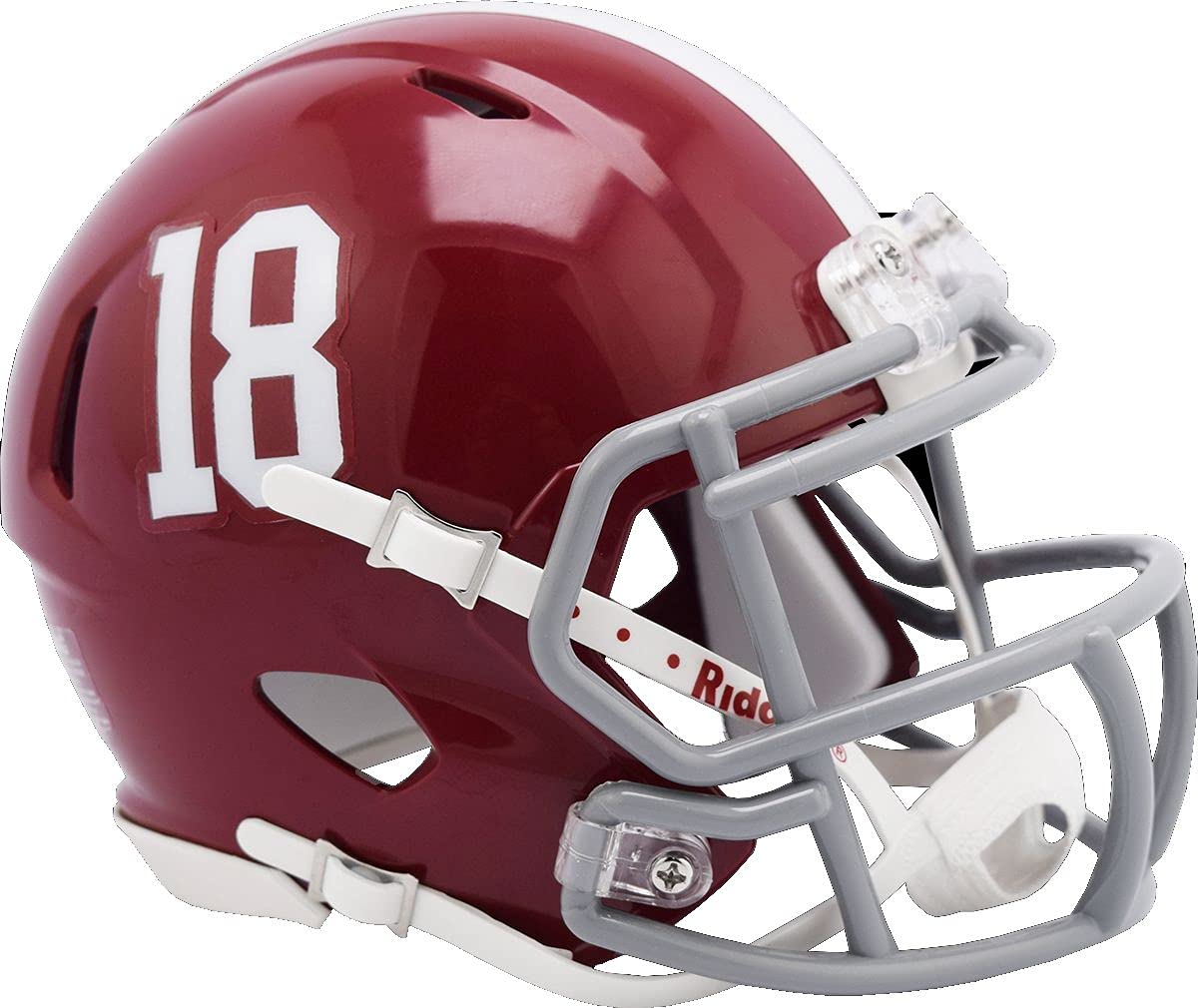
If you’ve ever typed “college football helmet” into a search bar and then stared at a results page full of identically photographed helmets wondering why one costs $19 and another costs $220, you are not alone — and you are not missing something obvious. The category has a genuine labeling problem. “Replica” is not a protected term. It appears on products ranging from a palm-sized novelty you could fit in a Christmas stocking to a full-size shell a receiver would recognize as game-adjacent. A mini helmet (sometimes called a “mini replica”) is roughly the size of a large orange — about 4 inches tall — and exists for display and autograph novelty. A full-size replica is a life-size shell, approximately 11–12 inches tall, that looks like a game helmet from a distance but carries no safety certification and should never be worn in play. A wearable helmet (also called a “practice” or “youth” helmet) is a certified piece of protective equipment built to NOCSAE standards (the National Operating Committee on Standards for Athletic Equipment). Different product, different price, different purpose. This guide maps all three tiers, names the tradeoffs explicitly, and ends with a clear decision rule for every buying scenario — gift, autograph, display, or kid who wants to actually put it on.
The Three Tiers, Side by Side
Understanding the category starts with accepting that the word “replica” is doing a lot of heavy lifting on retail packaging. Here’s how the tiers actually shake out.
By the Numbers
| Helmet Type | Approximate Height | Weight | NOCSAE Certified? | Typical Price Range |
|---|---|---|---|---|
| Mini replica | ~4 in | ~6–8 oz | No | $18–$40 |
| Full-size replica | ~11–12 in | ~1.5–2 lb | No | $60–$130 |
| Wearable (youth) | ~11–12 in | ~3–4 lb | Yes | $120–$300+ |
The visual overlap between a full-size replica and a wearable youth helmet is exactly what creates the most expensive buyer mistakes. Both look like real helmets in product photography. The difference is internal: a wearable helmet contains a certified liner, jaw pads, and a chinstrap assembly rated for impact. A full-size replica has a decorative interior — usually a minimal foam ring — and a facemask that is attached for aesthetics, not protection. Riddell’s product documentation makes this distinction explicit, labeling replica helmets as “collectible/display” items and wearable helmets under separate safety-rated product lines.
What Each Tier Is Actually Good For
Mini Helmets: The Misunderstood Compact
Mini helmets generate the most return traffic at customer service desks, largely because the product photo is shot with a telephoto lens that strips all size context. The most instructive size reference available in recent buyer reviews comes from the Texas Longhorns mini helmet — one reviewer noted, unprompted, that the helmet was roughly the same size as their chihuahua’s head. That’s not a complaint; it’s actually the clearest dimensional anchor you’ll find outside a ruler: four inches, maybe five, palm-sized, roughly the volume of a large navel orange.
Mini helmets are legitimately excellent for a narrow set of use cases:
- Desk or shelf display in an office or dorm
- Getting a signature when you want something portable and the signing line is long
- Stocking stuffers and lower-budget gifts ($18–$40 range)
- Starting a collection before committing to full-size pieces
The tradeoff: at 4 inches, a signature from a player with a normal adult hand will fill the entire visible surface of one panel. Some collectors love that — it looks bold. Others find it cramped. Beckett Authentication Services’ collector FAQ notes that mini helmets are a valid autograph canvas but recommends full-size replicas when the goal is a multi-signature piece (think a whole offensive line or a top-five recruiting class).
Full-Size Replicas: The Right Answer for Most Gift Scenarios
The full-size replica is the workhorse of the college football memorabilia segment, and it earns that status by threading the needle between cost and visual impact. At 11–12 inches, it photographs identically to a game helmet when displayed on a stand. The facemask, team decals, and color accuracy are noticeably more faithful to what teams actually wear on the field compared to mini versions, where the graphics are compressed and occasionally blurry at the edges.
Two real-world use cases reported consistently by reviewers illustrate the tier’s range:
Autograph events: The Riddell Ohio State Revolution Speed full-size replica has appeared repeatedly in reviews from fans who brought it to athlete signing events. Full-size replicas are the accepted standard at these events — players’ signatures read clearly, there’s room for multiple signers, and the piece displays well afterward on a standard helmet stand. JSA’s authentication FAQ confirms that full-size replicas are among the most commonly submitted items for autograph authentication, alongside footballs and jerseys.
Emotional gifting: One of the more memorable documented uses of the LSU full-size replica involved a hospitalized fan whose friends brought the helmet to the hospital and passed it around for everyone present to sign — a kind of impromptu get-well tribute that happened to also become a permanent keepsake. The piece’s size was what made it workable: enough panel space for a group of signatures, sturdy enough to survive being handled repeatedly, and visually meaningful in a way a mini wouldn’t have been. Sports Illustrated’s coverage of the college football memorabilia market has noted that signed pieces tied to personal stories — not just athlete signatures — represent a growing segment of collector sentiment.
The tradeoff: full-size replicas are not wearable. Not for kids, not for adults, not for Halloween, not for anything involving impact. The interior is decorative. The facemask is not reinforced for force absorption. This is the tier where buyer confusion is most consequential — one widely-circulated review gave five stars to a full-size replica while simultaneously announcing a return, because the buyer had wanted something a child could actually wear. The helmet earned the praise it got. It just wasn’t the right product.
Wearable Helmets: The Correct Choice for an Athlete
If the recipient is a child who wants to wear it — to practice, in the backyard, as part of any activity involving contact or movement — the product you want is a NOCSAE-certified youth helmet, not a replica of any kind. The price premium is real: certified youth helmets typically start around $120 and climb past $300 for premium shells. That premium exists because the liner, jaw pad system, and chinstrap are engineered to absorb and distribute impact force. A full-size replica’s decorative foam offers no meaningful protection. This is not a gray area.
The Display Case Compatibility Problem You Need to Know About
If your purchase plan includes a display case — specifically the JupDec helmet display case, which appears frequently in gift bundle searches — there is a critical compatibility issue buried in the review record that deserves prominent attention rather than a footnote.
A four-star review of the JupDec case includes a complaint that reads roughly as: the case fits authentic helmets but not replica helmets, which are slightly different in external dimension. This is not a universal complaint across all display cases, but it’s specific enough and credible enough to treat as a real risk rather than an outlier. The practical implication: do not assume any display case marketed for helmets will fit a replica helmet without verifying the internal dimensions against your specific helmet model’s external dimensions.
Riddell’s replica helmets and their authentic counterparts are not dimensionally identical — authentic game helmets typically have more pronounced exterior profiles due to additional liner thickness and chinstrap hardware. A case sized for an authentic helmet may have internal clearance that a replica helmet either swims in or, in rare cases, cannot fully close around due to facemask protrusion angle differences.
Before purchasing a display case alongside a replica helmet, confirm:
- The case’s internal depth (front-to-back, including facemask clearance)
- Whether the case is rated for “replica” or “authentic” or both
- Whether the facemask on your specific helmet detaches for flat-panel display
The Athletic’s coverage of the signed memorabilia market consistently notes that improper display cases are one of the leading causes of post-purchase dissatisfaction in the collectibles segment — not the helmet itself, but the case that doesn’t fit it.
Color and Graphics Accuracy: Managing Expectations
A question that appears in nearly every buyer community for college football helmets: how close do the colors and graphics actually look compared to what teams wear on the field?
The honest answer is tier-dependent. Across aggregated reviews, full-size replicas from licensed manufacturers earn consistently strong marks for color accuracy — Riddell’s officially licensed shells use team-approved Pantone color specs, and the decal application on full-size replicas is detailed enough to pass casual inspection even from someone who watches the team weekly. The facemask colors (which vary by team and sometimes by season) are sometimes simplified on replica versions — a chrome facemask on the game helmet may appear as a flat metallic gray on the replica — but reviewers generally rate this as a minor variance rather than a dealbreaker.
Mini helmets earn lower marks on graphics fidelity, specifically because the decals are compressed versions of the full artwork and can appear pixelated or smeared at close range. For shelf display at arm’s length, this is invisible. For a framed close-up photo or a high-resolution display shelf, the difference is noticeable.
Neither tier should be expected to match a game-worn helmet exactly. Game helmets receive team-specific preparation (custom decal placement, customized padding, player-specific fitting) that no mass-produced collectible replicates. The replica’s job is to evoke the team, not replicate the exact artifact.
Frequently Asked Questions
Can a child actually wear a Riddell full-size replica helmet for play? No. Full-size replica helmets carry no NOCSAE safety certification and are not designed to absorb impact. The interior is decorative. For any use involving play, contact, or physical activity, the correct product is a certified youth helmet.
What is the actual size difference between a mini Riddell helmet and a full-size replica? A mini helmet is approximately 4 inches tall and palm-sized — roughly the volume of a large orange. A full-size replica is approximately 11–12 inches tall and matches the visual footprint of a game helmet. They are not in the same size category despite similar packaging language.
Will a replica football helmet fit inside the JupDec display case? Not reliably. At least one detailed buyer review flags a fit incompatibility between the JupDec case and replica helmets, with the case appearing sized for authentic helmets instead. Verify internal dimensions — especially facemask clearance — before purchasing any display case alongside a replica helmet.
Are mini helmets good for getting autographs, or are they too small? They work for single signatures or two signatures from players with compact signing styles. For multi-signature pieces or a clean, readable signing from a player with a large hand, full-size replicas are the more practical and more displayable choice. Beckett’s collector guidance recommends full-size replicas for any autograph piece intended for long-term display.
How realistic do the colors and graphics look compared to what teams actually wear? Full-size replicas from licensed manufacturers consistently earn strong color-accuracy reviews, using team-approved color specifications. Minor variances in facemask finish are the most commonly noted gap. Mini helmets score lower on graphics fidelity due to compressed decal artwork.
Is a full-size replica helmet a good gift for someone who wants athletes to sign it? Yes — it’s the correct product for that purpose. Full-size replicas are the standard submission at signing events, accepted for JSA and Beckett authentication, and provide enough surface area for multiple signatures without crowding.
The Decision Rule
- If the recipient wants to wear it: Buy a NOCSAE-certified youth or adult helmet. Do not buy a replica.
- If the goal is a signed keepsake for display: Buy a full-size replica. Confirm display case internal dimensions before bundling.
- If the budget is under $40 and the use is desk display or a single signature: A mini helmet works. Set expectations on size upfront.
- If you’re buying for an emotional occasion — hospitalization, retirement, graduation — and want something that can hold a group’s signatures: Full-size replica, no question. It has the panel space, the visual weight, and the durability to become a lasting object rather than a novelty.
- If the facemask finish matters to you: Read the spec sheet before purchasing. Chrome and metallic finishes on game helmets are often simplified on replicas; reviewers flag this as the single most common color variance.
The category rewards buyers who ask one question before clicking: What will this helmet actually do on the day it arrives? Answer that honestly, then match the tier to the answer.